I’ve lost count of how many times I’ve pulled up a scan and seen the liver of an alcoholic staring back at me, while the person sitting across from me insists they feel totally fine. That gap – between how someone feels and what’s actually happening inside them – is really the whole story of this disease. So I wanted to write this the way I’d actually say it in clinic. No jargon, no scare tactics. Just what’s true.
How to Know if You Have Liver Disease? The Liver Just… Doesn’t Say Anything
Here’s the thing about the liver. It’s weirdly quiet. Other organs tend to complain – your knees ache, your stomach churns, you notice. The liver doesn’t really do that. It absorbs hit after hit and keeps going, right up until it can’t anymore, and by then you’re not exactly in the early stages of a problem.
That’s what makes drinking-related liver damage so easy to miss. Nobody feels the fat building up. Nobody feels the scarring start. It just… happens, quietly, in the background of an otherwise normal-feeling life.
Roughly, here’s how it tends to unfold:
- Fatty liver (steatosis): Fat starts collecting in liver cells after just days or weeks of heavy drinking. The good news? Fully reversible if you stop here.
- Alcoholic hepatitis: Inflammation kicks in. Enzymes go up. Some people finally feel a bit off – though plenty still don’t.
- Fibrosis: Scar tissue starts creeping in where healthy cells used to be. Function slips, even if the liver’s still technically doing its job.
- Cirrhosis: Widespread, permanent scarring. Filtering toxins, making proteins, managing clotting – all of it becomes a struggle.
And here’s the frustrating part – none of these stages come with an alarm bell. That’s usually the hardest thing for people to accept when I explain it to them.
Liver of an Alcoholic – What I Actually See, Week to Week
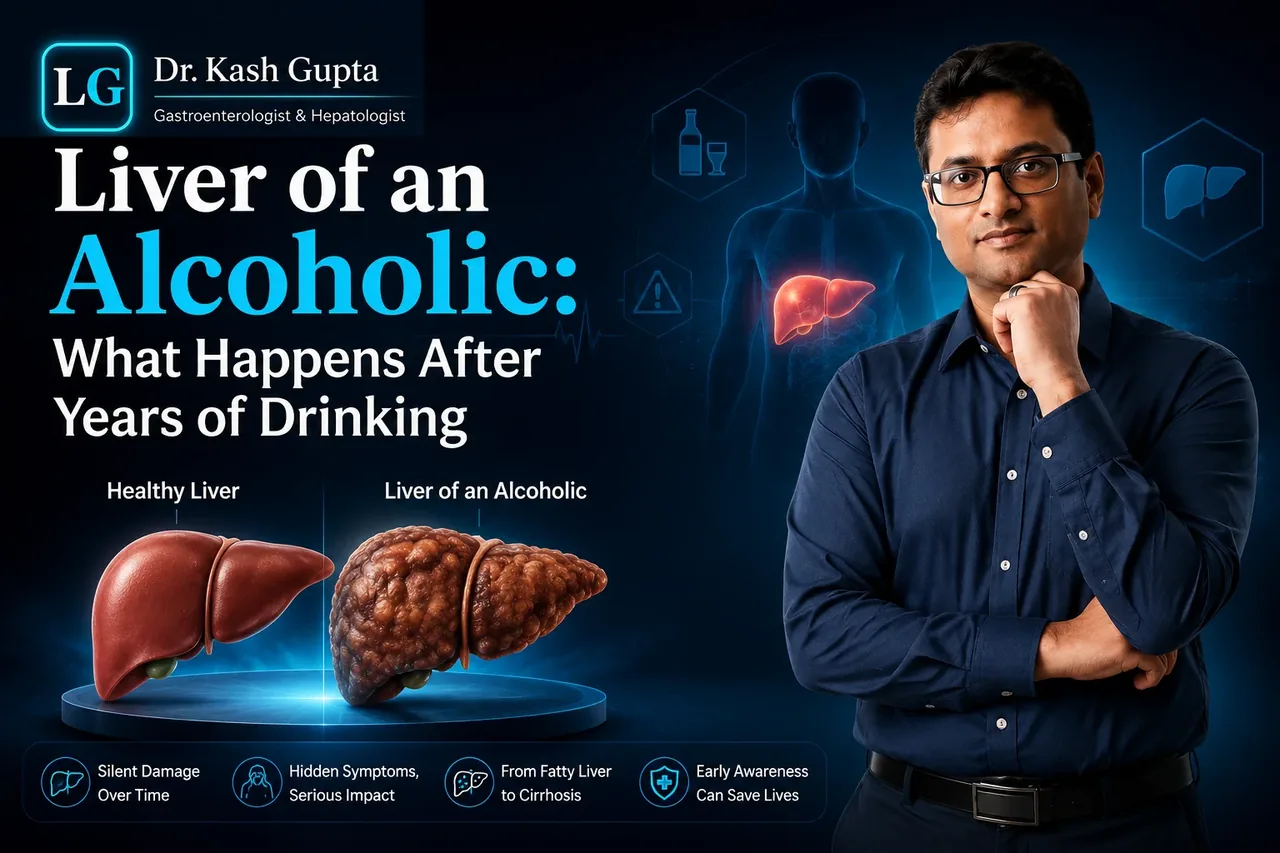
Honestly, most people assume damage this serious would announce itself somehow. It doesn’t. I’ve sat with patients who have real, advanced disease and they’ll still tell me, quite genuinely, “but I feel okay.” That’s often exactly what the liver of an alcoholic looks like after ten or fifteen years of heavy drinking – no drama, no obvious signal, just quiet deterioration.
A few things I’m always watching for:
- Tiredness that rest just doesn’t fix
- A dull ache or heaviness under the right ribs
- Weight or appetite dropping without any real explanation
- Puffiness around the ankles or belly
- A faint yellow tinge to the skin or the whites of the eyes
None of these scream “alcohol” on their own. But line them up against a long drinking history, and the picture gets a lot clearer, a lot faster.
If you want to understand how alcohol-driven damage differs from other causes of fatty liver, I went into more detail in Alcoholic vs Nonalcoholic Fatty Liver Disease – worth a look if you’re trying to figure out which one applies to you.
Why the Organ Itself Starts to Look Different
Think about how much passes through your liver every single time you drink. All of it, basically. Do that for years, and the organ doesn’t just get “tired” – it physically starts to change.
- Cells lose some of their natural knack for regenerating
- Scar tissue narrows the blood flow running through the liver
- Filtering ability drops, so toxins linger longer than they should
- Nutrient processing – proteins, vitamins – gets noticeably less efficient
This is part of why scans on long-term drinkers so often look different from a “normal” liver – nodular, enlarged, sometimes shrunken, depending on how far things have gone. It’s not really one disease with one moment of onset. It’s more like sediment building up, year after year, one drink at a time.
Is Liver Disease Curable? Can Any of This Actually Be Undone?
This is probably the question I get asked more than anything else, and I never give a flat yes or no, because it really does come down to timing.
- Fatty liver: Very reversible. Most people see real change within weeks of stopping.
- Hepatitis: Often reversible too, with real abstinence and proper support.
- Fibrosis: Partly reversible – some of the scarring can improve, though not all of it will.
- Cirrhosis: Largely permanent, unfortunately. At this stage, it’s about stopping further harm and managing what’s already there.
When people ask me straight out whether the liver of an alcoholic can heal, I tell them what I genuinely believe – this organ has an almost stubborn ability to regenerate, but that ability has a ceiling. The earlier you stop, the more of it you get to keep.
I’ve also written more on the early warning signs worth knowing in Fatty Liver Symptoms: Early Warning Signs to Know, which is a good companion read to this one.
What I’d Actually Say If You Were Sitting Across From Me
If you’re worried – about yourself, or someone you care about – here’s what genuinely matters, no fluff:
- Get a liver function blood test. Simple, quick, and tells you far more than you’d expect.
- If those numbers look off, ask about a FibroScan.
- Cut back, or stop, based on what your own doctor advises for your situation.
- Don’t wait for symptoms to show up. Feeling fine isn’t the same as being fine – I say that a lot, and I mean it every time.
Liver health rarely gets the attention it deserves. We talk endlessly about hearts, weight, blood sugar – and the liver just sits there, quietly absorbing the fallout of years of habits nobody ever questioned.
Final Thoughts
The liver of an alcoholic doesn’t fail in a single dramatic moment. It’s a slow, cumulative thing – small choices stacking up, year after year, until they finally show up on a scan. And the genuinely good news is that a lot of early damage can reverse, and even later-stage disease can often be managed well with the right care and the right timing.
If any part of this sounds a bit too familiar for you or for someone you love, please don’t wait for things to get worse before doing something.
I talk through real cases and questions like this on the Liver & Guts Podcast – honest, jargon-free conversations about liver and gut health.
And if you’d like a proper look at where you actually stand, you can book a private consultation with me directly.