Honestly, this topic comes up almost every single week in my practice. Someone gets a report, sees the words “fatty liver” on it, and completely panics. Then they spend three hours on Google and come to me with even more questions than when they started.
The biggest confusion? This idea that fatty liver disease is always about obesity. It’s not. Alcohol cause fat too. That assumption alone is causing people to miss something serious happening in their own bodies. So I wanted to break down alcoholic vs nonalcoholic fatty liver disease the way I’d actually explain it, sitting across from a patient, no filter.
Liver health is something I’ve dedicated a significant part of my career to. I work with patients navigating fatty liver disease every day – some drinkers, many not. Over the years, I’ve seen how badly this topic gets misunderstood. So here’s my honest, unfiltered breakdown of alcoholic vs nonalcoholic fatty liver disease.
The Thing Nobody Really Explains Properly
Your liver holds a small amount of fat naturally. That’s fine, that’s normal. But when that fat crosses a certain threshold – that’s when we start having a real conversation.
There are two roads that lead you there:
- Road one: The liver, trying to break it down, gets overwhelmed, and fat piles up.
- Road two:Nothing to do with alcohol at all.
Nonalcoholic fatty liver disease is a completely different story. These are my patients who don’t drink, or barely drink, and yet their liver is struggling just as much – usually because of weight, blood sugar problems, insulin resistance, or high cholesterol. Lifestyle stuff that’s become way too common.
Here’s the part everyone should pay attention to: both types can sit inside you for years, completely silent, causing zero symptoms. You feel fine. You look fine. The liver just quietly keeps getting worse.
What I’ve Seen With Alcoholic Fatty Liver Disease
When a patient comes in early and is willing to stop drinking, I’ve seen genuinely remarkable recoveries. The liver isn’t like most organs – it fights to come back. I’ve had people return three months after quitting alcohol with numbers almost unrecognizable from where we started.
But the ones who don’t stop? That trajectory is hard to watch:
- Fatty liver
- Alcoholic hepatitis
- Fibrosis (early scarring)
- Cirrhosis (permanent damage)
There’s no coming back from cirrhosis, not fully. And to be clear – this isn’t about a few rough weekends. This is sustained, heavy drinking over months and years. That’s what tips the scales.
What I’ve Seen With Nonalcoholic Fatty Liver Disease
This one genuinely worries me more at a population level.
I’ve had perfectly healthy-looking patients come in for something completely unrelated, and we find fatty liver on a scan almost by accident. No symptoms, no warning, nothing. They’re shocked. I’m not – I see it constantly now.
NAFLD is linked to how a lot of us are living: processed food, not moving enough, extra weight around the middle, blood sugar creeping up. What makes this scarier than AFLD in some ways is that it can quietly progress into NASH – inflammation plus actual cell damage. From there: fibrosis → cirrhosis → in some cases, liver cancer. All the while, the person felt completely fine for years.
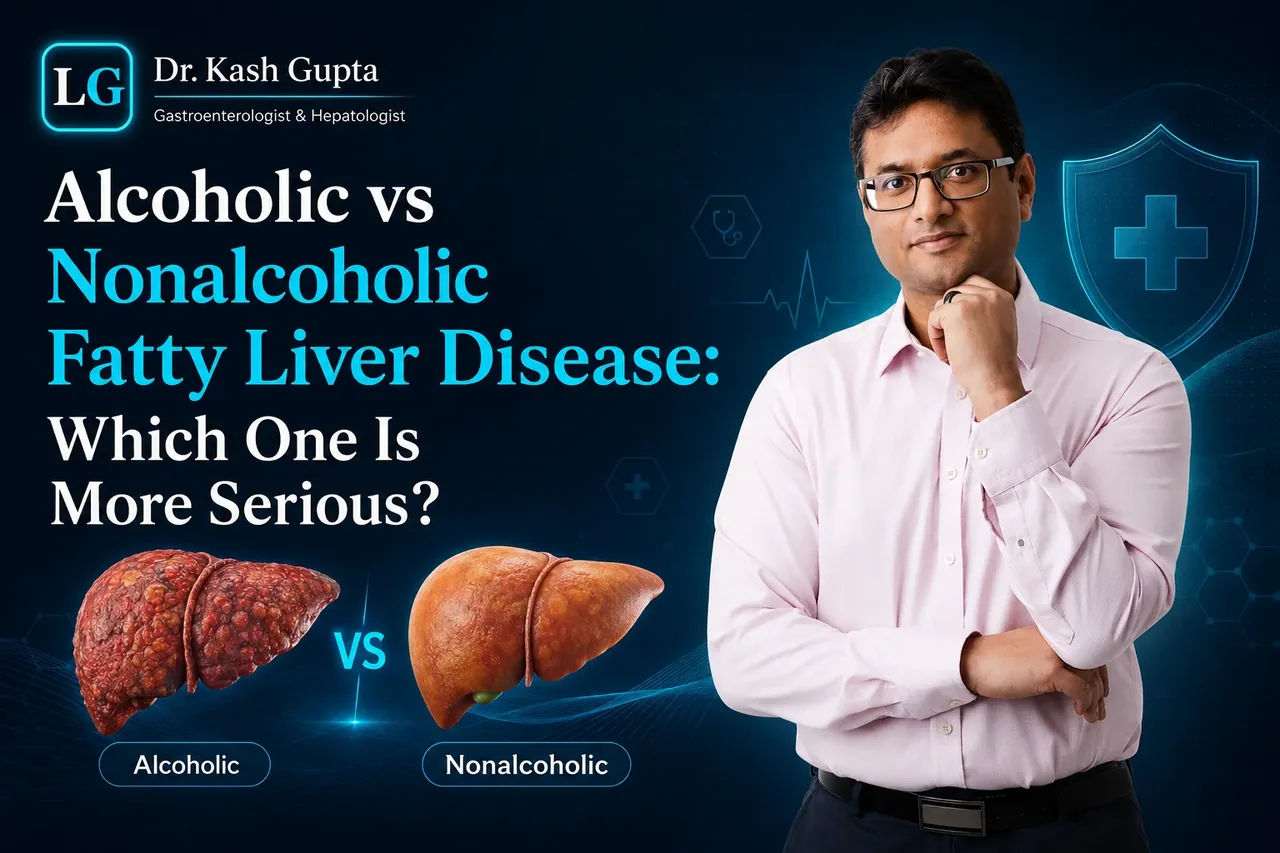
Comparing the Two: Alcoholic vs Nonalcoholic Fatty Liver Disease at a Glance
Alcoholic (AFLD) |
Nonalcoholic (NAFLD) |
|
| Main cause | Heavy, long-term drinking | Obesity, diabetes, poor diet, inactivity |
| Reversible? | Often, if alcohol stops early | Often, with weight loss & lifestyle change |
| Progression | Hepatitis → fibrosis → cirrhosis | NASH → fibrosis → cirrhosis → possibly cancer |
| Common in | Long-term heavy drinkers | Increasingly common even in non-drinkers |
| Often paired with | Alcohol use disorder | Diabetes, heart disease, metabolic syndrome |
| Usually found | Easier to suspect from drinking history | Often found by accident – it’s quiet |
Which One Is More Serious?
I get asked this directly, and I always say the same thing: both are serious. The difference is in how they get serious.
- AFLDmoves faster when the person keeps drinking, because alcohol is actively damaging the liver with every single drink. The harm is constant and compounding.
- NAFLDmoves more slowly but hides better. It takes longer to cause major damage, but by the time it’s found, it’s often already been progressing for years. Because there’s no obvious habit to point at, people don’t think to look for it.
Globally, NAFLD is now thought to affect upto 38 percent of people. Sit with that number for a second.
Symptoms Worth Paying Attention To
Don’t shrug off:
- Fatigue that doesn’t really go away
- A dull ache under your right ribs
- Losing weight without trying to
- Skin or eyes turning yellowish
- Swelling in your legs or stomach
If any of that sounds familiar, that’s a reason to get checked – not a reason to start Googling symptoms at 1 a.m.
Can You Reverse It?
Here’s the genuinely encouraging part – true for both types.
For AFLD: Stopping alcohol completely is the main thing, combined with decent nutrition and, if needed, medical support during withdrawal.
For NAFLD, it usually comes down to:
- Steady weight loss (even 7–10% of body weight goes a long way)
- Reducing sugar and processed foods
- Exercising more
- Controlling diabetes or cholesterol, if present
Your liver can repair itself – which is honestly kind of remarkable. But that window closes once scarring becomes permanent, so earlier is always better. Whichever side of the alcoholic vs nonalcoholic fatty liver disease divide you fall on, the right intervention – caught in time – makes a real difference.
Don’t Try to Figure This Out Alone
I’ll be straight with you: this isn’t something to self-diagnose from an article, including this one. Liver health depends on too many individual factors – genetics, existing conditions, and how far things have already progressed.
This is what I, Dr. Kash Gupta, discuss daily. My primary areas of interest are liver and metabolic health, and I love being able to explain this stuff without getting lost in medical mumbo-jumbo.
For more, listen to my podcast on YouTube – less a standard health lecture, more a real conversation about liver disease, metabolic health, and actual lifestyle change. It’s a great place to start if you’re trying to understand a diagnosis or simply want to stay one step ahead.
Press play on the latest episode of Liver & Guts and let Dr. Gupta walk you through what your liver might actually be trying to tell you, before it has to shout louder to get your attention.