Have you ever wondered what your gut is trying to tell you?
You eat something completely normal, and an hour later you’re quietly unbuttoning your jeans under the desk. You sleep a full eight hours and still wake up feeling like you never went to bed. By 3 pm, your brain feels like it’s wading through fog.
Sound familiar? I hear this from patients all the time. And almost every week, someone shows me a carrier bag of supplements they’ve been sold online, hoping one of them is the answer. Usually, most of them aren’t. So let’s be honest about which gut health supplements are actually worth your money — and, just as importantly, when you don’t need them at all.
It’s Not Just About Your Stomach
This is the part most people miss. Your digestive system isn’t a passive tube that sits quietly on the side. Over the years, I’ve seen how far the gut reaches — into your immune system, your mood, your skin and your thinking. When it’s off balance, you don’t just feel it in your stomach; you feel it everywhere.
But here’s the thing I want to be straight with you about: I don’t hand supplements out to every patient, and I don’t take a fistful of them myself. In clinic, I only reach for them in specific situations, for specific reasons. For most people, most of the time, the biggest wins come from food, sleep and stress — not from a shelf full of bottles.
The Honest Truth About Gut Supplements
Walk into any pharmacy or scroll any wellness page and you’ll find a wall of gut health supplements promising to fix everything. Most of it is noise, and a lot of it is expensive noise.
A supplement is exactly that — a supplement. It works best on top of a decent foundation, not instead of one. Before you spend a penny, it’s worth knowing that a few genuinely evidence-backed options exist, and that they each suit a particular situation rather than everyone across the board.
Your Gut Has Been Trying to Tell You Something
Most people wait until things get genuinely uncomfortable before they think about their gut. In my experience, the signals show up much earlier:
- Bloating that turns up almost every time you eat
- Bathroom habits that feel like a coin flip week to week
- Brain fog that rolls in out of nowhere
- Skin suddenly reacting to things it used to tolerate
- Foods you’ve eaten your whole life no longer agreeing with you
None of this is simply “how it is” as you get older. Often a few sensible diet tweaks — and, in the right situation, one well-chosen supplement — can turn things around faster than people expect.
What Actually Has Evidence Behind It
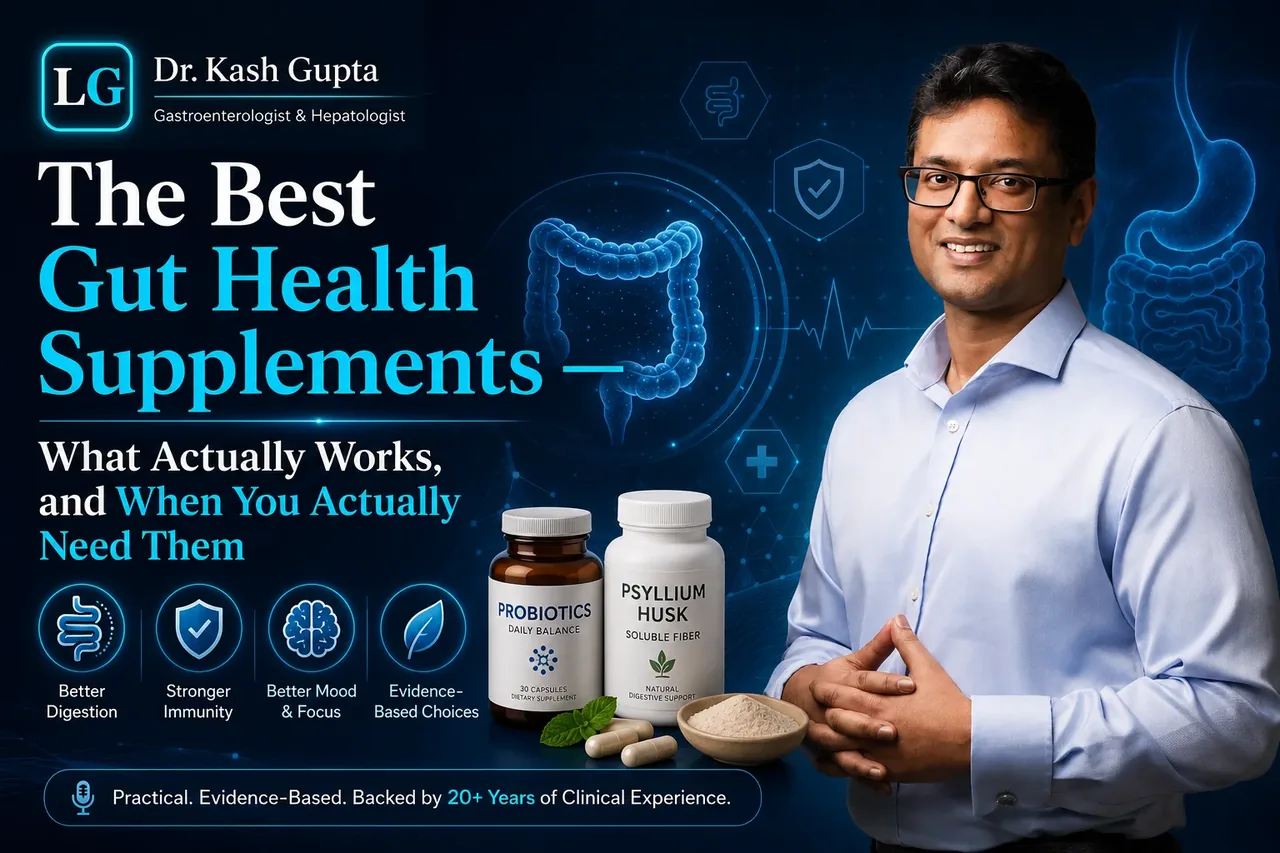
Here are the options I think are genuinely worth knowing about. Notice how short the list is — that’s the point.
Soluble fibre (such as psyllium / ispaghula husk)
If I had to pick one place for most people to start, it’s this. Soluble fibre gently bulks and softens stool, feeds your good bacteria, and can settle both constipation and loose, unpredictable bathroom habits. It’s cheap, it’s food-adjacent, and it’s about as close to a safe default as gut supplements get.
Peppermint oil (enteric-coated capsules)
One of the better-evidenced options for cramping, spasm and bloating, particularly for people with IBS-type symptoms. The enteric coating matters — it’s what lets the oil reach the gut rather than giving you heartburn on the way down.
Probiotics — but only in the right circumstances
Probiotics get talked about as an everyday must-have. I don’t see them that way. They earn their place in specific situations — for example, alongside or just after a course of antibiotics, or as a time-limited trial (usually a few weeks) if you’re working through IBS symptoms. If you try one, give it a fair trial, judge whether it actually helped, and stop if it didn’t. They aren’t something most people need to take forever, and the strain matters far more than the packaging.
A quick word on prebiotics and “gut lining” products
Prebiotics are simply food for your good bacteria — and for most people, the best source is real fibre on your plate, not a concentrated powder. In fact, in sensitive guts, strong prebiotic supplements can make bloating worse, not better. Start with food first.
What I’ve deliberately left off the list
You’ll often see digestive enzymes, L-glutamine and omega-3 marketed as gut essentials. I’ve left them off on purpose. Digestive enzymes genuinely help people with certain diagnosed conditions, but there’s little good evidence they do much for everyday bloating in an otherwise healthy gut. L-glutamine is mostly tied to the “leaky gut” idea, where the evidence is thin and largely from the lab rather than real patients. And omega-3, whatever its other merits, doesn’t have convincing evidence as a gut supplement specifically. Being honest about what to skip saves you money — and that matters just as much as knowing what to try.
A Quick Cheat Sheet
Supplement |
Best for |
How it helps |
| Soluble fibre | Bloating, irregularity, constipation | Bulks and softens stool, feeds good bacteria |
| Peppermint oil | Cramps, spasm, IBS-type bloating | Relaxes the gut muscle to ease pain |
| Probiotics | After antibiotics; short IBS trial | May help rebalance bacteria — situationally |
| Whole-food fibre | Everyday gut health | Natural, gentle food for your microbiome |
You don’t need all of these sitting on your counter. The smarter move is working out which one — if any — your body is actually asking for, and that’s where real expert guidance beats guesswork.
When a Supplement Actually Makes Sense
The honest answer is: it depends on you. The same bottle that helps one person does nothing for the next, because their symptoms, their diet and their gut are different. That’s exactly the kind of thing I unpack in more detail on the podcast and in my courses — matching the right approach to the right person, rather than reaching for the same jar for everyone.
Why You Should Give the Liver & Guts Podcast a Listen
If any of this has you curious about your own gut, come listen to the podcast. Every episode is free and grounded in real medical research. Here’s what you’ll get:
- Which gut health supplements are worth your money — and which are clever marketing
- Practical, no-nonsense ways to look after your liver
- How to actually improve digestion without falling for the next detox fad
- Honest myth-busting on cleanses and quick fixes
It’s the kind of show where you finish an episode actually understanding something — not just having heard another confident opinion shouted into a microphone.
Where to Start
- Notice your symptoms instead of pushing through them. Bloating and fatigue are signals, not background noise.
- Build the foundation first — real, whole foods, decent fibre, sleep — before you buy anything.
- If you do try a supplement, pick one, not five, and give it a fair run.
- Judge honestly whether it helped. If it didn’t, stop — and save your money.
- Get your information from someone who knows the science, not whoever’s loudest online.
Your Gut’s Been Talking. Maybe It’s Time to Answer.
You shouldn’t have to plan your whole day around how your stomach feels. The right approach — the occasional well-chosen supplement, sitting on top of good everyday habits — can genuinely change how you feel. I’ve built my career on giving people honest, evidence-backed answers instead of empty promises.
Head over to drkashgupta.com to explore my work, read more about my background, give the Liver & Guts Podcast a listen, or subscribe to my newsletter for weekly gut and liver insights straight to your inbox. It might be exactly the nudge your gut has been waiting for.